ICE 287(g) Program Tracker
Using the Report + Methodology
Suggested citation: Thrasher, Andrew. ICE 287(g) Program Tracker. Titus Consulting. Data as of [DATE]. https://www.tituslegaldesign.com/immigration-101/287g-program
Using the Report + Methodology
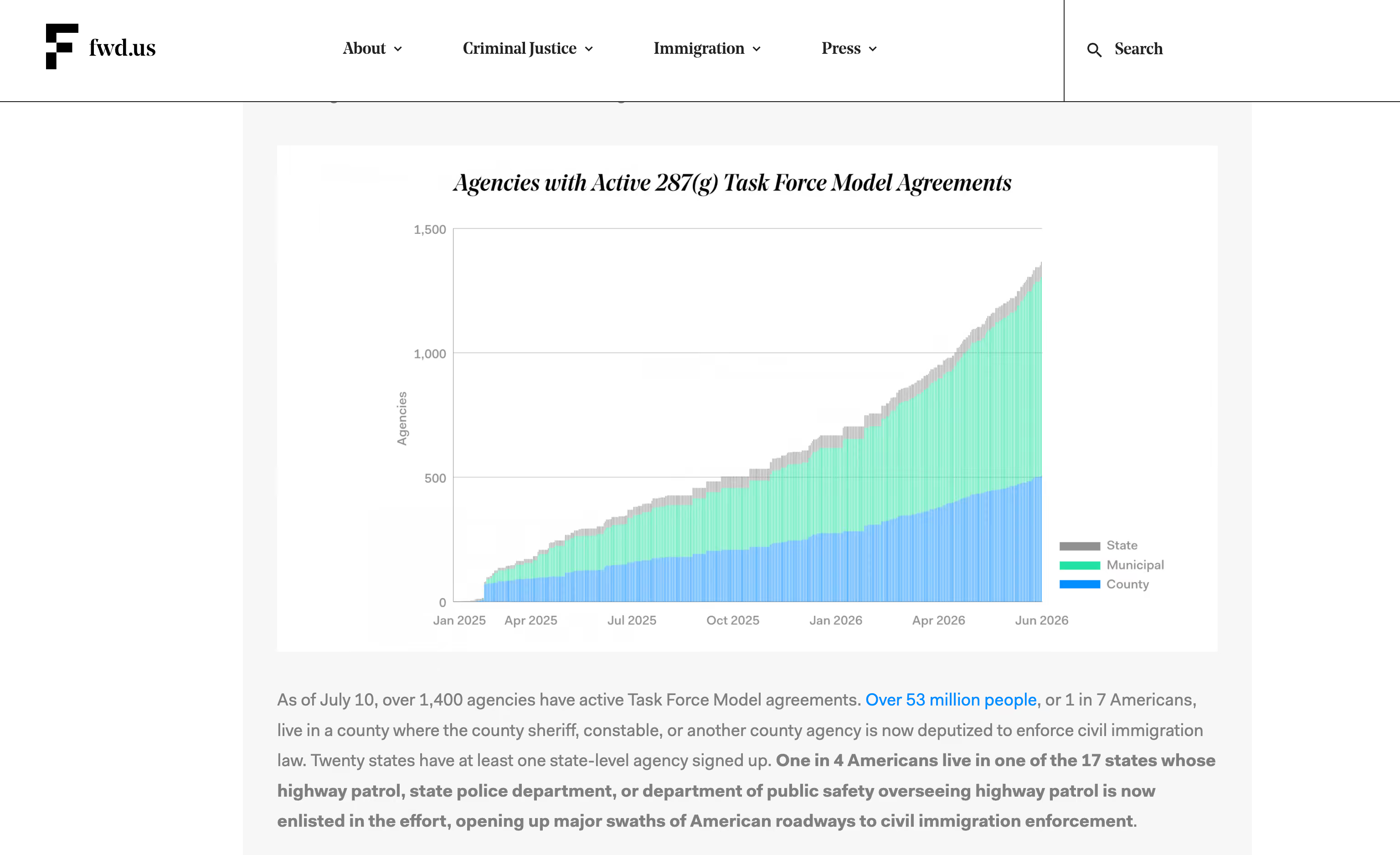
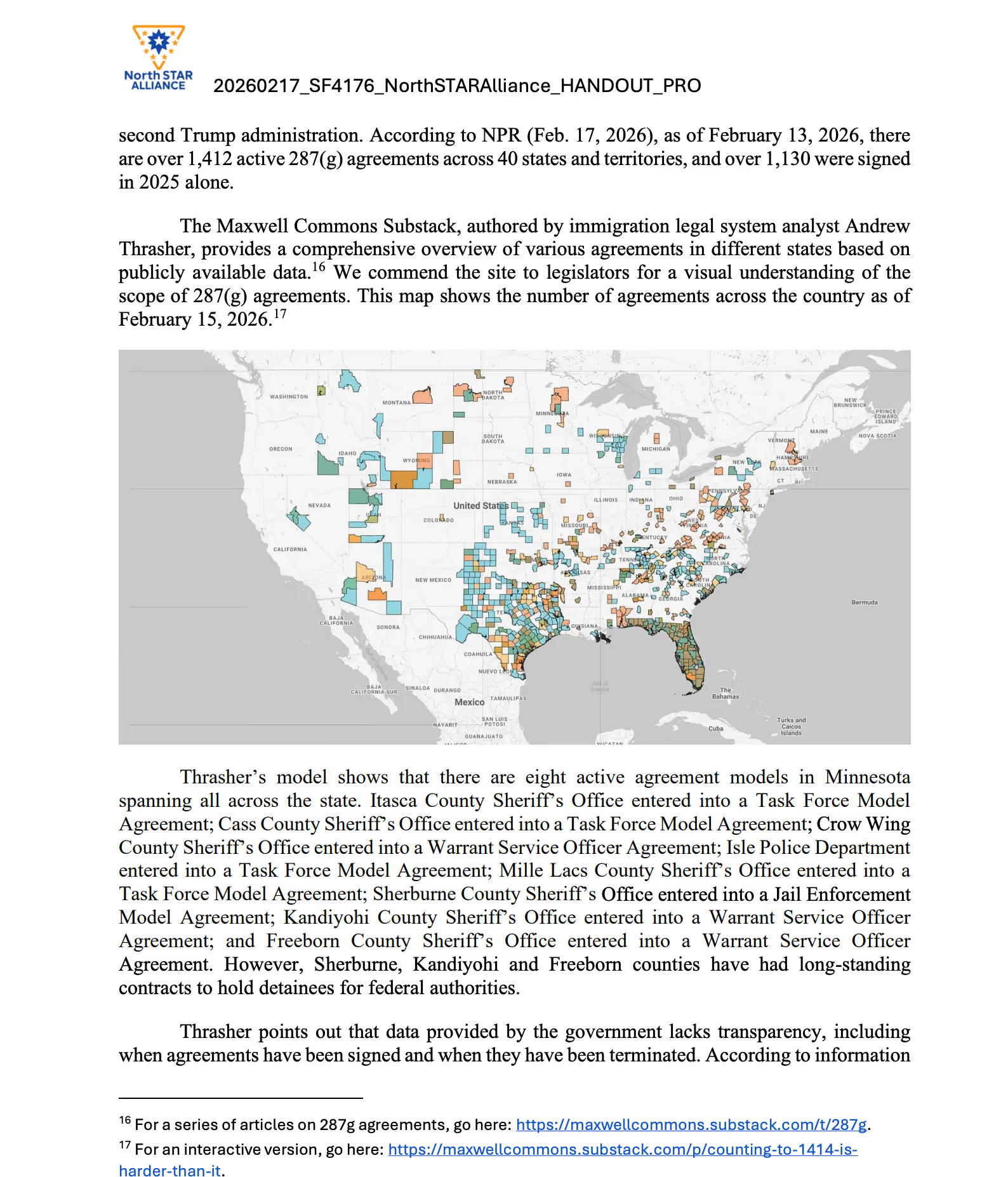
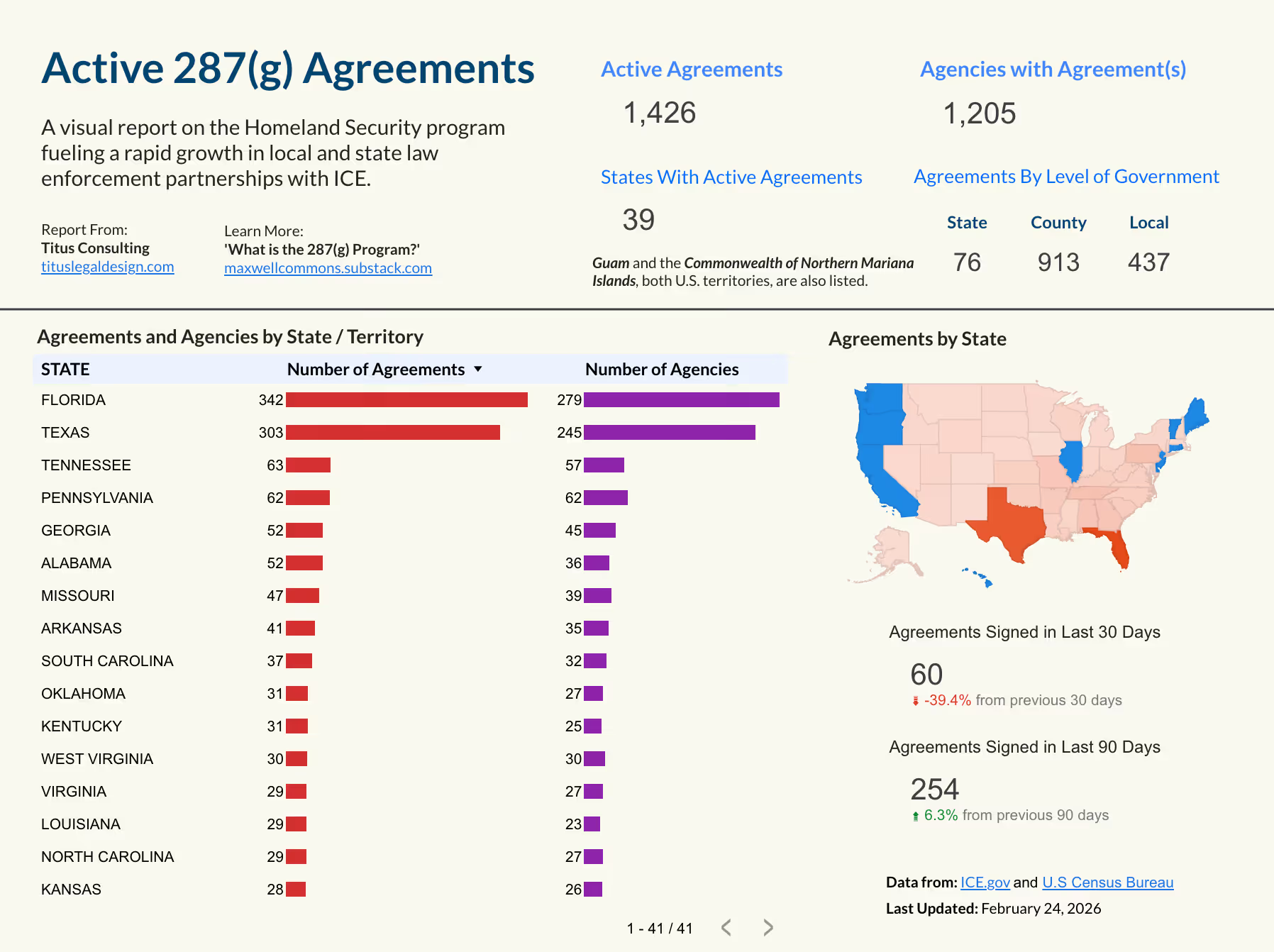
One participating agency can have up to three (3) agreements active — one for each of the 287(g) program models. When this report references the total number of agreements, that figure will always be equal to or greater than the number of unique participating agencies.
For example: the 1,770 active agreements recorded on April 30, 2026 corresponded to 1,493 unique agencies.
Both figures are meaningful, and they answer different questions. The agreement count describes the total scope of delegated immigration enforcement authority. The agency count describes how many distinct law enforcement bodies (or 'LEAs') are participating. Comparisons across sources frequently break down because one party is counting agreements and the other is counting agencies — when citing a figure from this report, please specify which one you mean.
ICE publishes a new spreadsheet of active agreements roughly every day or two, but the schedule is inconsistent and ICE does not announce changes or offer update notifications. For this report, changes ICE's snapshot publishing process is captured and processed manually, typically within 24 hours of a detected change.
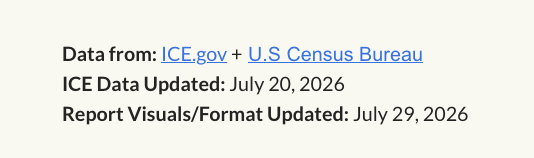
Agreement numbers in this report are, therefore, as-of figures. The report home page lists the effective date of the underlying snapshot in the top right corner ('ICE Data Updated'). Please refer to that date when citing as-of totals from the report.
ICE does not maintain a list of canceled agreements. When updates are made to ICE's active agreement list, the published file — an Excel spreadsheet downloaded from ICE's 287(g) landing page — represents the agreements active at the time of publication. In other words, the previous snapshot of the list is replaced entirely. There is no public changelog, no archive of prior files, and no unique identifier assigned to each agreement. When a row is removed from the spreadsheet, or an edit is made (like changes to the signature date or agency name), there is no public record of these changes.
Cancelations in this report are, therefore, reconstructed. The report author maintains a local archive of ICE's published spreadsheets in order to identify changes across each data snapshot published by ICE. Any agreement present in the prior snapshot but absent in the new one is flagged and reviewed manually across the current and previous snapshots before it is added to the canceled agreement list in this report (and removed from the active agreement list). This approach allows us to account for several false positives and other common pitfalls related to how ICE manages this data:
Known Limitation: Agreement cancelation tracking only covers agreements removed from ICE's published list on or after December 8, 2025, because reconstructing removals requires a pre-existing archive of snapshots and our current archi ve begins on that date. Any agreement added and removed from ICE's list before December 8, 2025 is not currently documented in this report.
The arrest analysis uses ICE enforcement data released under FOIA and processed by the Deportation Data Project. The dataset covers 713,464 administrative arrests recorded between October 1, 2022 and March 10, 2026.
Each administrative arrest is a unique record of "every time ICE arrests someone, whether or not that arrest results in a decision to detain the person."
In the arrest data shared to Deportation Data Project by ICE, there is no single field that identifies 287(g) involvement. Instead, the program surfaces inconsistently across three (3) separate fields. We classify an arrest as 287(g)-related if any one or more of the following conditions is true:
Apprehension method = "287(g) program"Final program = "287G Program" OR "287g Task Force"Operation = HQ Tracking of Processing done by 287(g) authorized State & Local LEAs"This is a union (logical OR), not a weighted or hierarchical test. All three tags are treated as equally sufficient, and no arrest is counted more than once regardless of how many tags it carries.
Applying this filter results in 29,500 287(g)-related arrests, with 192 records excluded as likely duplicates, as flagged by the Deportation Data Project.
The variance across the three fields is itself an indicator for how inconsistently ICE codes its own enforcement activity, and it means any single-field approach would substantially undercount.
Please also note this statement from Deportation Data Project, on concerns with the underlying data from ICE:
We have several concerns about this new dataset.
First, and most important, we continue to have questions about the reliability of the encounters and removals data. These encounters and removals datasets are similar to the October versions but different from the late July release that we believe was most reliable. A comparison of the October and late July removals datasets is available here.
Second, in this version of the dataset, ICE omitted detention stints in hospitals and medical centers. This affects a small number of stints relative to the total—and therefore should not prevent analysis of the detention data—but it makes analysis of hospital stints impossible.
Third, ICE has redacted the “case_category” values for some individuals; comparing this release to previous releases suggests that these are mostly individuals who had credible fear interviews. For some of the individuals, ICE has also redacted detention release reasons (in the detentions table) and processing disposition values (in the encounters and removals tables). To obtain some of this missing information, we suggest joining the detention and removals tables to determine which individuals were booked out to be removed.
While the above concerns relate to ICE's encounter, detention, and removal datasets — not the administrative arrest data — it's important to note the inherent quality and credibility concerns related to any data provided by ICE at this point in time.
What it shows: The 287(g)-related share of ICE's monthly administrative arrests rose from 2.9% in January 2025 to 9.5% in January 2026. Over the same period, the month-to-month growth in 287(g)-related arrests and the growth in total ICE administrative arrests indicate a strong positive correlation (r = 0.86).
What it doesn't show: The correlation coefficient describes the relationship between 287(g)-related arrests and total ICE administrative arrests — it is not a correlation between arrests and the number of active agreements, and it is not a causal estimate. Both series grew steeply over an interval marked by a large increase in ICE funding, staffing, and other operational changes, and no attempt has been made here to isolate the independent contribution of the 287(g) program or relative impact of individual participating agencies. The defensible claim is that the composition of ICE arrests shifted materially toward local partner agencies. Claims stronger than that are not necessarily supported by this initial analysis.
Note also that the underlying dataset ends March 10, 2026, and so lags the agreement data by a considerable margin. The two should not be plotted against each other, and context should be provided on the non-concurrent totals.
Two distinct funding streams are tracked, and it is recommended to keep these figured delineated (rather than combining into one total):
1. Federal reimbursements and incentives: Before October 2025, DHS covered only training costs and limited software reimbursements. The One Big Beautiful Bill Act (OBBBA) changed this, and in September 2025 DHS began marketing a set of financial incentives to Task Force Model agencies, effective October 1, 2025: vehicle grants (up to roughly $100,000 per agency), technology and surveillance software subscriptions, officer payroll and overtime, and quota-based bonuses tied to arrests and other ICE-assigned work. The OBBBA additionally authorized a $3 billion DOJ grant program for 287(g) agencies.
2. State grant programs: Several states run their own programs to encourage agencies to join. Tracked examples include Tennessee (a $75 million sheriffs' program conditioned in part on demonstrated progress toward a 287(g) agreement), Texas (SB 8, with $4.9 million awarded to 59 counties since January 1 via the state comptroller), and Florida (the State Board of Immigration Enforcement, with over $21 million confirmed against at least $250 million set aside).
Critically, ICE does not publish payment data. There is no federal register of which agencies have been paid, when, or how much. Every federal figure in this report was assembled from secondary evidence: local and investigative journalism built on public records fights, state-level award listings where a state publishes them, agency budget and auditor documents, and at least one leaked agency document. The financial data in this report should be treated as an incomplete aggregation of 3rd-party evidence, not a comprehensive record of public data or the direct results of the author's own public records requests, unless noted.
Because of this, the payment figures are a non-random convenience sample and represent a lower bound only. An agency showing no confirmed payment in this report has not been shown to be unpaid — it has only not been the subject of a successful records request or news investigation. Coverage, therefore, skews toward participating jurisdictions with active local newsrooms, independent reporters and investigative journalists, etc.; as well as states with statutory disclosure requirements. These figures must not be aggregated into a national total or used to compare states.
Separate from general reimbursements, ICE offers Task Force Model partner agencies a set of cash incentives, up to $22,500 per case, for work related to locating and interviewing minors (and their families, caretakers, educators, etc.) who entered the country as 'unaccompanied alien children' (UAC) — comprising up to $2,500 in "case incentives" (address verification and residence confirmation) and up to $20,000 in "safety verification" incentives (in-person verification of a minor's home situation and school enrollment, reported back to ICE).
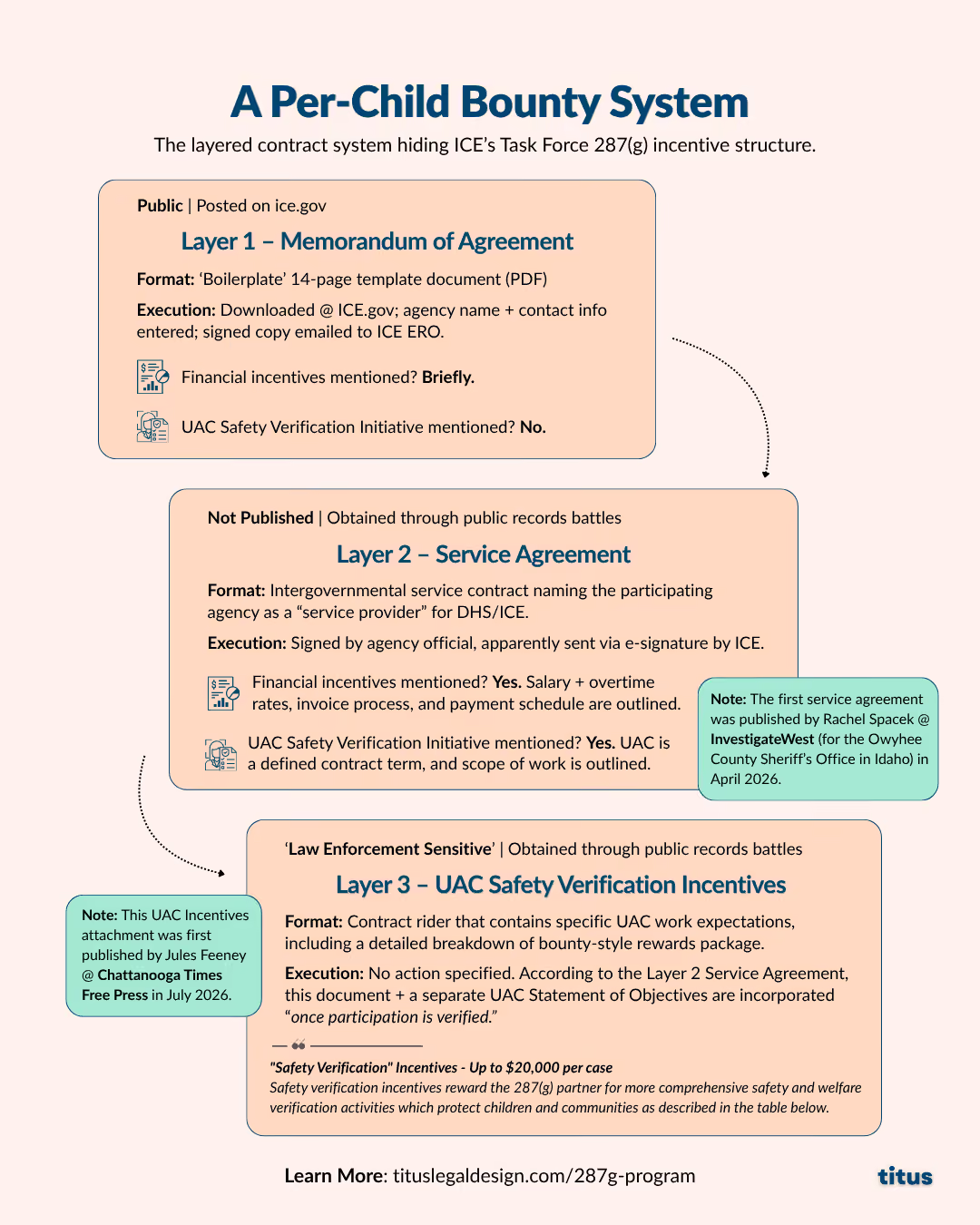
This structure is not visible in the public Memorandum of Agreement template. It sits in a three-layer contract system:
The second and third layers only entered the public record through the work of journalists in winning public records requests locally. The service agreement via InvestigateWest's reporting on the Owyhee County Sheriff's Office (Idaho), and the incentives rider via the Chattanooga Times Free Press's reporting on Bradley County, Tennessee constables.
This report reflects those documents as published; while agency-specific terms + conditions may vary, the author is not aware of any publicly-available evidence demonstrating different financial incentives offered to other agencies (as of August 03, 2026).
Please cite this report with the as-of date of the underlying snapshot, and specify whether you are citing agreements or agencies when referring to program totals.
Suggested format: Thrasher, Andrew. ICE 287(g) Program Tracker. Titus Consulting. Data as of [DATE]. https://www.tituslegaldesign.com/immigration-101/287g-program
The enriched dataset and report visuals are published openly under MIT License. Journalists and researchers who need the raw processed dataset, a historical snapshot, or clarification on a specific record are welcome to get in touch.
The report tracks agreements executed under Section 287(g) of the Immigration and Nationality Act, which authorizes ICE to delegate specified immigration enforcement functions to state and local law enforcement agencies. It covers three program models — Jail Enforcement Model (JEM), Warrant Service Officer (WSO), and Task Force Model (TFM) — across county, municipal, and state levels of government.
The primary unit of analysis is the agreement, not the agency. Agency-level counts are deduplicated.
ICE publishes an Excel file of currently active agreements on its 287(g) program page. Publication is irregular and unannounced. Each file is a complete replacement of its predecessor and reflects only the agreements active at time of publication. ICE provides no changelog, no version history, and no persistent unique identifiers.
Reconstructed by differencing consecutive locally archived snapshots. See §3.2. Coverage begins December 8, 2025.
ICE administrative arrest records obtained under FOIA and processed by the Deportation Data Project. Represents 713,464 arrest records recorded between October 01, 2022 and March 10, 2026. Used solely for the 287(g)-related arrest analysis section of the report; this data is not joined to the agreement dataset at the record level. For more on Deportation Data Project's data processing, please refer to the organization's 'ICE core data codebook'.
Compiled from published journalism, state award listings, agency budget and auditor records, and leaked documents. Maintained in two places in the source dataset: a 'Confirmed TFM Reimbursements + Invoices' field on the agreement record (when independently verified), and a separate State Grants table. Not a systematic collection. See §6.4.
Each published ICE file is downloaded manually and filtered by 'Signed' date to identify agreements newly added to ICE's snapshot raw data. After processing and manual enrichment ('Location' field) and automated enrichment ('Population' field, which pulls Census data automatically).
Each new snapshot is compared against the immediately preceding snapshot using a composite key of state + agency name + agreement type + signature date. Rows present in the prior snapshot and absent from the new one are flagged as potential cancellations; rows present in the new snapshot only are flagged as potential additions.
Because the composite key contains no stable identifier, it is sensitive to upstream edits. Every flagged row is reviewed and cross-checked manually before classification, specifically to distinguish genuine removals from renamings, re-signings, and model switches (see FAQ above).
The published report reflects a processed version of ICE's data. Processing is limited to independently verifiable data, and consists of:
Corrections are recorded in the 'Notes' field on the affected record. Two representative examples:
Signature date: ICE's published list shows a signature date of February 23, 2025 for the Ottawa County Sheriff's Office (OK). The corresponding Memorandum of Agreement published by ICE shows February 23, 2026. The report reflects the date in the MOA.
Agency name: The Iuka Police Department (MS) was initially published by ICE as "Luka Police Department." Corrected to "Iuka" against the agency's own records.
Standing rule: Where ICE's published list conflicts with an underlying primary document published by ICE itself, or similar primary evidence, the primary document controls, and the discrepancy is noted on the record.
No historical series is published by ICE. Every time-series figure in this report is reconstructed and bounded by the start of our own archive.
The composite key is a known weak link in the pipeline. A silent upstream edit to an agency name or signature date breaks the match and can generate a spurious cancellation-plus-addition pair. Manual review helps mitigate this issue, but does not eliminate the fragility entirely. Users should treat single-record cancellation claims with slightly more caution than aggregate trends, particularly because we have seen some records removed from ICE's published list and subsequently re-added several days later (occasionally with other, substantive, edits made).
The classification depends entirely on ICE's own coding processes, which are demonstrably inconsistent across the three fields we use in this analysis— almost certainly representing an undercount of total 287(g)-related arrests across this period of time. The reported correlation (r = 0.86) between 287(g)-related arrests and total ICE administrative arrests is descriptive, and supports no causal inference. The arrest dataset terminates March 10, 2026.
The single largest limitation in the report. There is no federal disclosure system for 287(g) reimbursement requests or confirmation of distributed payments. Each of the recorded figures in this report comes from verified media reports (including interviews with participating agency officials), public records releases, and/or other official evidence or trusted media documentation. The absence of a payment record carries no evidentiary weight. Coverage is geographically biased toward jurisdictions with active newsrooms and independent reporting, as well as states with government disclosure requirements. Do not aggregate to a national total, and do not use for cross-state comparison.
"Not Found" values in the 'Population' field are heavily concentrated among constable offices and similar sub-county jurisdictions, typically listed by ICE at the municipal level (under 'Type'). Population-weighted analyses should exclude, rather than impute, these records.
ICE has historically over-counted agreements by including the header row in its own sums. Typographic and data entry errors are routine. Any figure attributed to ICE directly, including ICE's own published totals, should be independently verified.
Every figure is an as-of figure tied to a snapshot date, which is displayed on each report page. Corrections to individual records are logged in the 'Notes' field of the primary agreement dataset.
Methodology version: v1.0 — Last revised August 04, 2026.
The dataset is published under the MIT License. Attribution is requested. Researchers needing the processed dataset, an archived snapshot, or clarification on a specific record may contact us.